
Picture a nonprofit executive director with two quotes on her desk. One is from a freelancer for a few thousand dollars. The other is from an agency for five times that. Both promise a beautiful new website. Her board wants to know why they shouldn’t just take the cheaper one, and honestly, she’s wondering the same thing.
If you’ve searched for help with this decision, you’ve probably noticed something: almost every article is written by an agency explaining why you need an agency, or by a freelancer explaining why you don’t. This one is written by a studio that has seen both sides of this question for decades.
Reliability, quality, and process (in addition to price) are all important
- A freelancer is one person. Your project is shaped by their skills, their availability, and their working style. When they’re great, it’s great. When they’re overloaded, sick, or out of their depth, there’s no backup.
- An agency is a team with a process: strategists, designers, developers, project managers. There’s depth and redundancy, but also layers between you and the people doing the work.
- A studio sits in between. A small, senior team where the people you meet are the people who design and build your site, with an established business standing behind the work.
When a freelancer is the right call
A good freelancer is a smart choice when:
- You need a single landing page, an event microsite, or a simple brochure site.
- Your scope is clear and unlikely to change.
- Your budget is tight and you have someone on staff who can manage the project and the site after launch.
- You need a specific specialty, such as illustration or a particular platform, for a focused piece of work.
If that’s you, look for someone with a strong portfolio of similar projects, a written contract, and a clear answer to “who maintains this after launch?”
When a solo freelancer can’t cover everything, someone has to coordinate the designer, the developer, and the copywriter. That someone is usually you.
When you need more than one person
Projects get harder when several disciplines have to work together. That’s usually when:
- You need branding and a website at the same time, and they need to feel like one thing.
- Your site connects to other systems: donation platforms, CRMs, event registration, email marketing.
- Your needs go beyond the website: print collateral, video, ongoing brand work. That’s more than one person can reliably deliver.
- Accessibility matters (and it should). Meeting WCAG standards takes deliberate design and development, not a plugin.
- The site needs ongoing security updates, backups, and care for years, not weeks.
There’s also a hidden cost here. When a solo freelancer can’t cover everything, someone has to coordinate the designer, the developer, and the copywriter. That someone is usually you. If you’re a small nonprofit team already stretched thin, becoming the accidental project manager can cost more in staff time than you saved on the quote.
The agency trade-offs nobody mentions
Agencies solve the coordination problem, but they come with their own trade-offs:
- The handoff. The senior person in the sales meeting may not be the one building your site. Work often gets passed to junior staff once the contract is signed — worth asking about upfront.
- Rigid process. Structure has its place, but at agencies it can make small changes slow and expensive. Change orders add up.
- Lock-in. Some agencies build on proprietary platforms or hold your hosting and admin credentials in their own name. Before signing anything, confirm in writing that you own your domain, your hosting account, and full admin access — not them.
- Overhead. Big offices, account managers, and project coordinators are real costs. They show up in your invoice whether you use them or not.
Whatcom Families
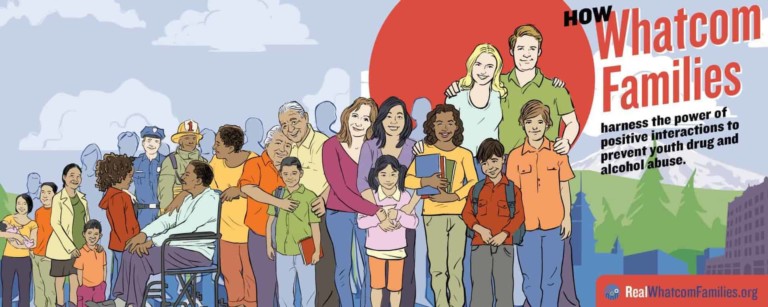
Case study: When Whatcom Families set out to build a parent education site, they needed more than a web designer. They needed one partner who could handle all of it. We designed and built the site, and we also wrote the content that guides parents through it, from the topic headers to the section introductions. Their small team never had to act as go-between for a designer, a developer, and a copywriter, or reconcile three different visions of what the site should be. The result is a site where the design, structure, and voice all come from the same understanding of who the audience is and what they need.
The studio model (and where Shew Design fits)
We’ve been designing brands and websites in Bellingham for 25 years, mostly for small businesses and nonprofits. Here’s what that looks like in practice:
- You work with the people doing the work. No junior handoff, no game of telephone.
- Brand and web under one roof. We started as graphic designers, so your website is built as an extension of your brand, not a template with your logo dropped in.
- Lean, custom builds. We avoid bloated page builders. That means faster sites, fewer things to break, and more room for work that actually stands out.
- We’re still here. Twenty-five years of continuity means the team that built your site is the team that will maintain it.
A quick checklist before you hire anyone
Whoever you’re talking to, ask these questions:
- What’s my realistic budget, including care and updates after launch?
- Does my project need branding, content, integrations, or accessibility work in addition to design?
- Who will actually design and build my site? Will I meet them?
- Who maintains the site after launch, and what does that cost?
- Will I own my domain, hosting, and full admin access?
- What happens if the person I’m working with becomes unavailable?
- Can you show me similar projects you’ve completed, and can I talk to those clients?
A note for nonprofits and small businesses
Nonprofits face constraints most web articles ignore: grant timelines, board approvals, budgets that can’t flex mid-project, and small staffs with no time to manage a vendor. A partner who understands those realities will plan phases around funding cycles and hand you a site your team can actually update.
So, which should you choose?
If your project is small, clear, and self-contained, hire a great freelancer. If it’s a large, multi-department platform with an enterprise budget, a full-service agency may make sense. And if you’re a small business or nonprofit that needs a brand and website that work together, built by senior people who’ll still be around in five years, that’s exactly the space a studio like ours was built for.
Not sure which you need? Get in touch. We’ll give you an honest answer, even if that answer is “hire a freelancer.”
Questions and Answers
How long does a website project take?
It depends on scope — a focused site moves faster than one with databases, integrations, or a lot of content to organize. Two things drive the timeline more than anything else: how quickly content and feedback come back to us, and how many rounds of review each stage needs. Our process runs in clear phases — planning, sitemap and wireframes, a working prototype, design, then launch — and each one settles a set of decisions before the next begins, so the project keeps moving instead of circling. Most projects run eight to twelve weeks. We’ll give you a realistic timeline once we understand what you’re building, and we keep you in the loop the whole way.
What should I look for in a web design agency?
Look for a partner who handles strategy, design, and development together — the gaps between those hand-offs are where projects stall. Ask how you’ll manage the site afterward: it should run on a platform you control, with content you can update yourself, without code. Be wary of sites built on bloated tools packed with features you’ll never use — they tend to break and are hard to fix. And ask what happens after launch, because good partners train your team and stick around for support. We show you a working prototype early, before the visual polish, so you can see how everything functions and there are no surprises at the end.